
A refrigerator that hums but will not chill is losing either airflow or heat exchange, and the clock is real — hours, not days. Here is the order to check things in, and the point where you stop checking and call.
Five-minute homeowner triage
Confirm settings did not get bumped, feel for airflow at the freezer vents, make sure food is not blocking them, and check that the door gaskets seal a slip of paper snugly. A packed-solid fridge with blocked vents mimics a dead one surprisingly well.
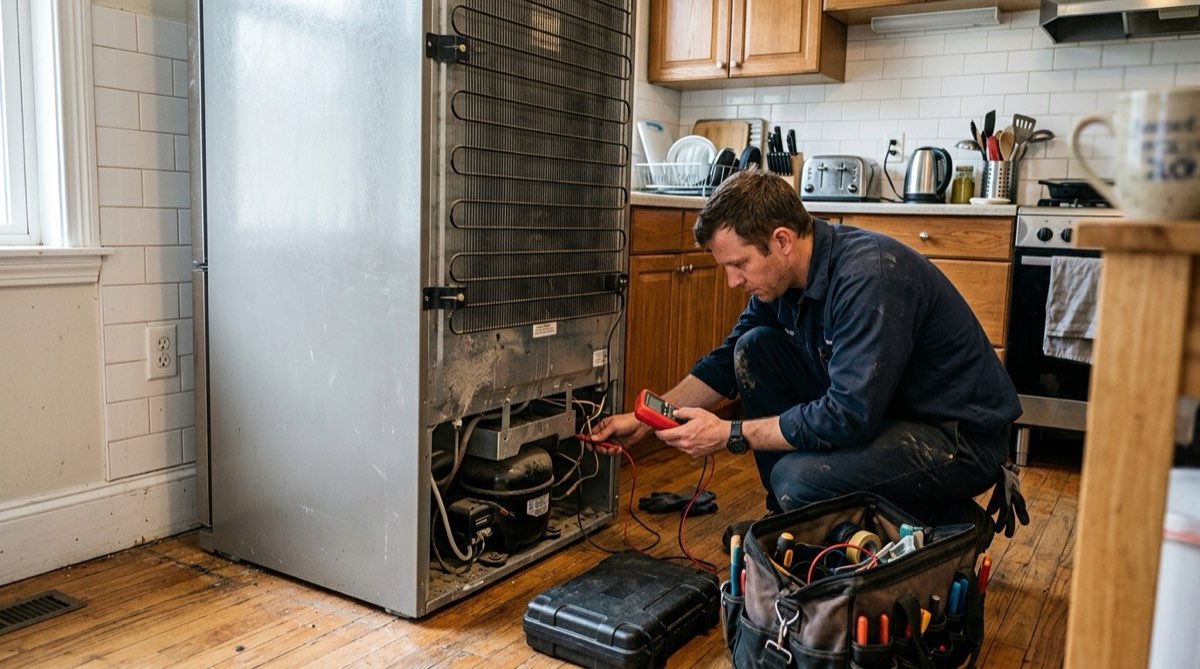
Then pull the machine forward and look underneath and behind: coils matted in dust and pet hair are Springfield's most common 'broken fridge' — the machine cannot dump heat through a felt blanket.
What the sounds mean
Silence where the compressor hum should be points at the start relay or compressor. A fan that has gone quiet — condenser fan below, evaporator fan behind the freezer wall — explains warm zones fast. Clicking every few minutes is the relay trying and failing; that one deserves a same-day call.
Frost patterns are evidence
A frost-clogged evaporator panel means the defrost system failed — heater, thermostat, or control. It thaws into a working fridge and refreezes into a warm one on a repeating cycle, which is why 'it fixed itself for two days' is a diagnostic clue, not good luck.
Buy time while you wait
Keep doors shut, group food into coolers with ice only if the box is fully warm, and resist emptying the freezer — thermal mass is on your side. Around Greene County most cooling failures are relay, fan, or defrost parts: same-visit fixes when the model number rode along with the booking.
The one-hour rule
Run the five-minute triage; if nothing obvious turns up, make the call within the hour rather than watching the thermometer creep. Cooling failures never improve on their own, and the difference between a relay swap and a full defrost teardown is often just time.
Mention the sounds, the frost pattern if you saw one, and the model tag — and keep the doors closed until the truck arrives.